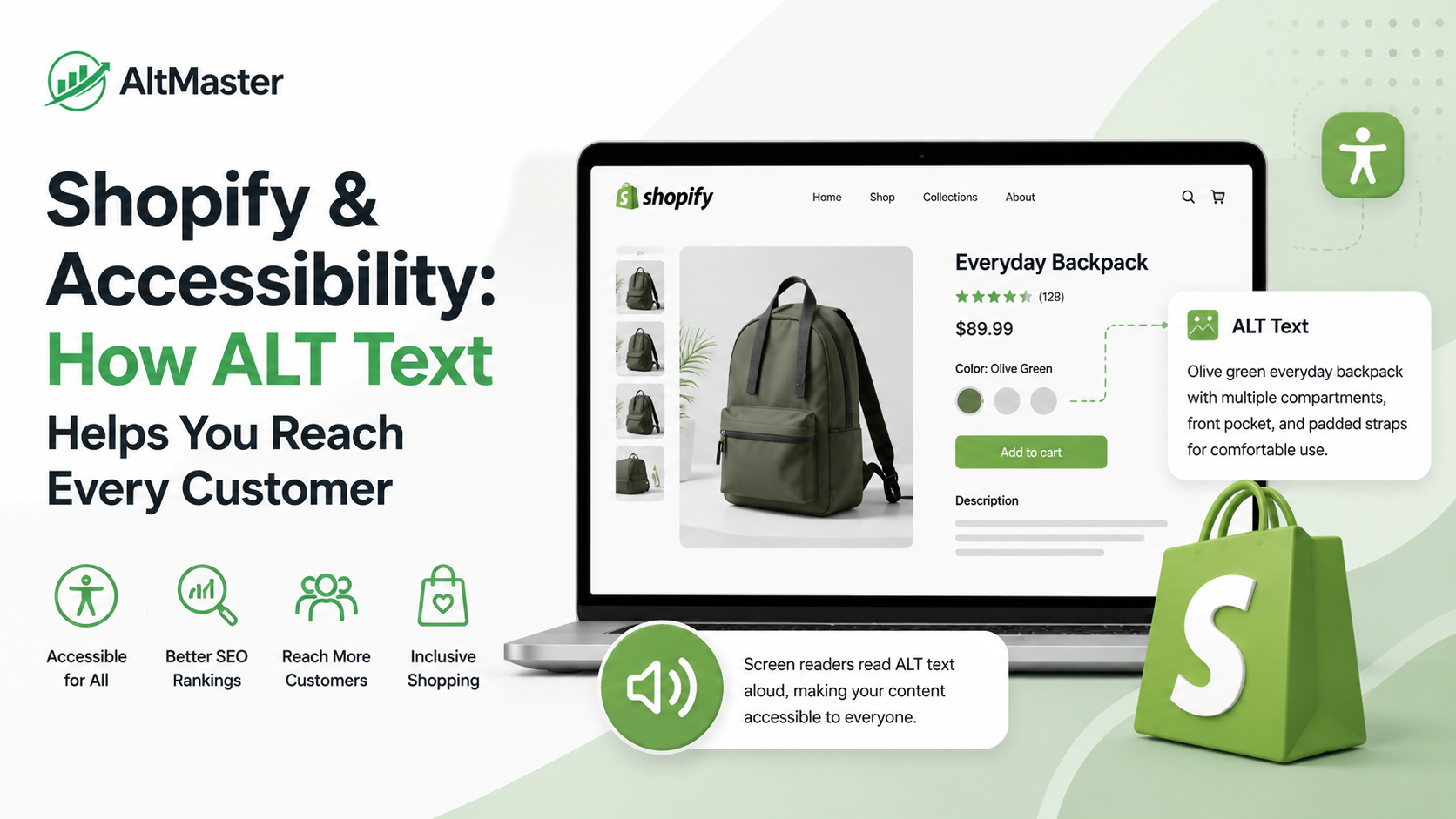
Most conversations about ALT text start and end with SEO. And fair enough - it's a real ranking signal, and it's worth fixing for that reason alone. But there's a more human side to this that doesn't get talked about enough: real customers can't use your store without it.
Around 1.3 billion people globally live with some form of disability. A significant portion of them shop online, use screen readers to navigate product pages, and rely entirely on ALT text to understand what they're looking at. If your product images are blank, those shoppers aren't getting a degraded experience - they're getting no experience at all.
That's worth taking seriously, independently of any SEO benefit.
Accessibility Is Not Optional Anymore - Here's Why It Matters for Shopify Stores
The idea that accessibility is a "nice to have" for small stores is outdated. eCommerce accounted for 70% of all ADA digital accessibility lawsuits in 2025, and missing image ALT text was one of the most frequently cited barriers in those complaints - specifically on product pages where shoppers rely on images to make buying decisions.
Fashion and apparel ranked second among all industries targeted, accounting for over 25% of lawsuits. If you sell clothing, accessories, or lifestyle products on Shopify, you're operating in one of the highest-exposure categories.
And it's not just the US. The European Accessibility Act became enforceable in June 2025, making digital accessibility a direct compliance requirement for any business selling to EU customers - not just a litigation-driven concern.
This is the landscape. The question isn't whether accessibility matters for your store. It's whether you want to address it now or wait until someone else forces the issue.
What Visually Impaired Shoppers Experience in Your Store Right Now
When a screen reader user visits your Shopify store, they're not seeing your product photos - they're hearing a description read aloud by assistive software. Every image on your page gets announced in sequence: the product name, the colors, the details, the lifestyle context.
That's the experience when ALT text exists. When it doesn't, the screen reader either reads the raw filename aloud, announces "image," or skips the element entirely - leaving the user with lost context and an incomplete picture of what they're trying to buy.
Imagine trying to purchase a product when the only thing you hear is "IMG underscore 4821 dot JPG." You wouldn't. You'd leave. And that's exactly what happens - those shoppers leave and buy from a competitor whose store actually works for them.
How ALT Text Bridges the Gap Between Your Products & Every Customer
How Screen Readers Use ALT Text to Describe Products
Screen readers - software like JAWS, NVDA, and Apple's built-in VoiceOver - read page content aloud in a logical sequence. When they hit an image, they read the ALT text. That description is often the only information a visually impaired shopper has about your product.
Good ALT text for a product image sounds like: "Navy blue slim-fit linen shirt - relaxed collar - front view." In a couple of seconds, the shopper knows what it is, what color it comes in, how it fits, and which angle they're looking at. They can make a decision. They can buy.
That's the job ALT text does - not just for Google's crawler, but for a real person sitting at their computer or phone trying to shop your store.
What Happens When ALT Text Is Missing or Wrong
Missing ALT text is the obvious failure. But wrong ALT text - keyword-stuffed, copy-pasted across all variants, or completely unrelated to the image shown - creates a different problem. A screen reader user who hears the same description for six different color variants of a product has no idea which one they're actually selecting. That's a broken shopping experience, and it's entirely avoidable.
The benchmark that governs this is WCAG 2.1 Level AA - the Web Content Accessibility Guidelines maintained by the W3C. It's the standard referenced in ADA lawsuits, the European Accessibility Act, and most global accessibility regulations. It requires meaningful, descriptive ALT text for all non-decorative images - and it's the bar your Shopify store should be meeting.
Accessibility & SEO: Two Goals, One Solution
How Writing for Accessibility Naturally Improves Rankings
The formula for accessible ALT text and the formula for SEO-optimized ALT text are essentially the same: describe what's actually in the image, specifically, in one natural sentence. Product name, color or material, context or view. Write it for a person who can't see the image - and it naturally includes the keywords a customer would search for.
This isn't a coincidence. Google's image understanding systems work similarly to screen readers: they read text descriptions to build context around what an image contains. The AltMaster blog covers why ALT text still matters for image search rankings and AI-powered product discovery in 2026 - and the conclusion is the same: accessibility-first writing and SEO-optimized writing point to the same output. You're not making a trade-off between them.
The Legal Side: Accessibility Laws Shopify Stores Can't Ignore
Over 5,000 digital accessibility lawsuits were filed in 2025 - a 27% increase over 2024 - and eCommerce accounted for nearly 70% of all cases. These aren't just targeting major retailers. The majority of cases targeted smaller online stores under $25 million in annual revenue, which means if you're running a Shopify store of any size, you're in the exposure zone.
The average cost of defending and settling an ADA website lawsuit runs between $60,000 and $200,000 - significantly more than the cost of simply fixing the underlying issues. And 45% of 2025 lawsuits targeted companies that had already been sued before, meaning getting sued once and not fixing the root cause dramatically increases future exposure.
ALT text alone won't make your store fully WCAG compliant - keyboard navigation, color contrast, and form labels matter too. But missing ALT text is one of the most consistently cited violations in ADA complaints, and it's one of the easiest to fix. For a complete picture of what all three angles - SEO, screen reader experience, and legal compliance - mean for your store specifically, the AltMaster guide covering why ALT text is essential for every Shopify merchant covers it in full.
This Is Where AltMaster Comes In
Fixing ALT text store-wide isn't just an SEO task anymore - it's an accessibility and compliance task that affects every product, every variant, and every collection page simultaneously. For a store with 200 products and 5 images each, that's 1,000 individual fields to fill in correctly.
AltMaster scans your full Shopify catalog, surfaces every image missing ALT text, and generates descriptions in bulk using product-specific variables - name, color, material, variant - so every image gets a meaningful, specific description. Not just a filled-in field, but ALT text that actually works for screen reader users and search engines alike. Run it once to fix your existing catalog, and it keeps new products covered automatically as your store grows.
How to Write ALT Text That Serves Both Shoppers & Search Engines
The formula is simple and works for both purposes:
Product name + color or material + view or context, in one natural sentence.
- Navy blue slim-fit linen shirt - front view ✅
- Handmade ceramic mug with speckled glaze - 12oz - lifestyle shot ✅
- shirt blue buy now ❌
- IMG_4821 ❌
For variant images, each color or material gets its own specific description - never copy-paste across variants. Sage green linen shirt - front view and navy blue linen shirt - front view are different ALT texts for a reason: they're describing different things.
For decorative images - background textures, dividers, purely aesthetic graphics - an empty ALT attribute (alt="") is the correct approach. Screen readers skip empty ALT attributes intentionally. Every image that carries product information, however, needs a real description.
For a complete step-by-step walkthrough of exactly how to add and manage ALT text across your Shopify store - both manually for smaller catalogs and in bulk for larger ones - the AltMaster guide to adding ALT text in Shopify covers the full process from start to finish.
Conclusion
ALT text sits at the intersection of three things that matter: who can use your store, how well you rank on Google, and whether you're exposed to legal risk. Fixing it properly addresses all three at once - and unlike most SEO or compliance work, it doesn't require a developer, a big budget, or weeks of planning.
Start with your best-selling products. Write ALT text that describes what's actually in each image. Build a system for the rest of your catalog so it doesn't stay half-done. Every customer who can now navigate your store fully is a customer who couldn't before - and that's worth something independent of any ranking benefit.
FAQs
Is my Shopify store legally required to have ALT text?
There's no single law that mandates ALT text by name, but missing ALT text is one of the most consistently cited violations in ADA website accessibility lawsuits - and courts have found that inaccessible ecommerce sites violate ADA Title III. If you sell to US customers, ADA applies. If you sell to EU customers, the European Accessibility Act has been enforceable since June 2025. Both standards require meaningful alternative text for product images.
Does accessibility actually affect my store's Google ranking?
Yes, indirectly. Google treats user experience as a ranking signal, and accessibility improvements often directly overlap with UX improvements. More directly, ALT text is a confirmed signal for image search rankings and reinforces the topical relevance of your product pages. Writing accessible ALT text and writing SEO-optimized ALT text produce the same output - there's no conflict between the two goals.
How do I know if my store has missing ALT text right now?
The fastest way is to export your product CSV from Shopify (Admin → Products → Export) and check the "Image Alt Text" column. Every blank cell is a missing ALT text. For a more complete store-wide audit that catches collection images and theme assets too, AltMaster's free ALT text checker tool scans your entire store and shows you exactly where the gaps are before you commit to fixing anything.