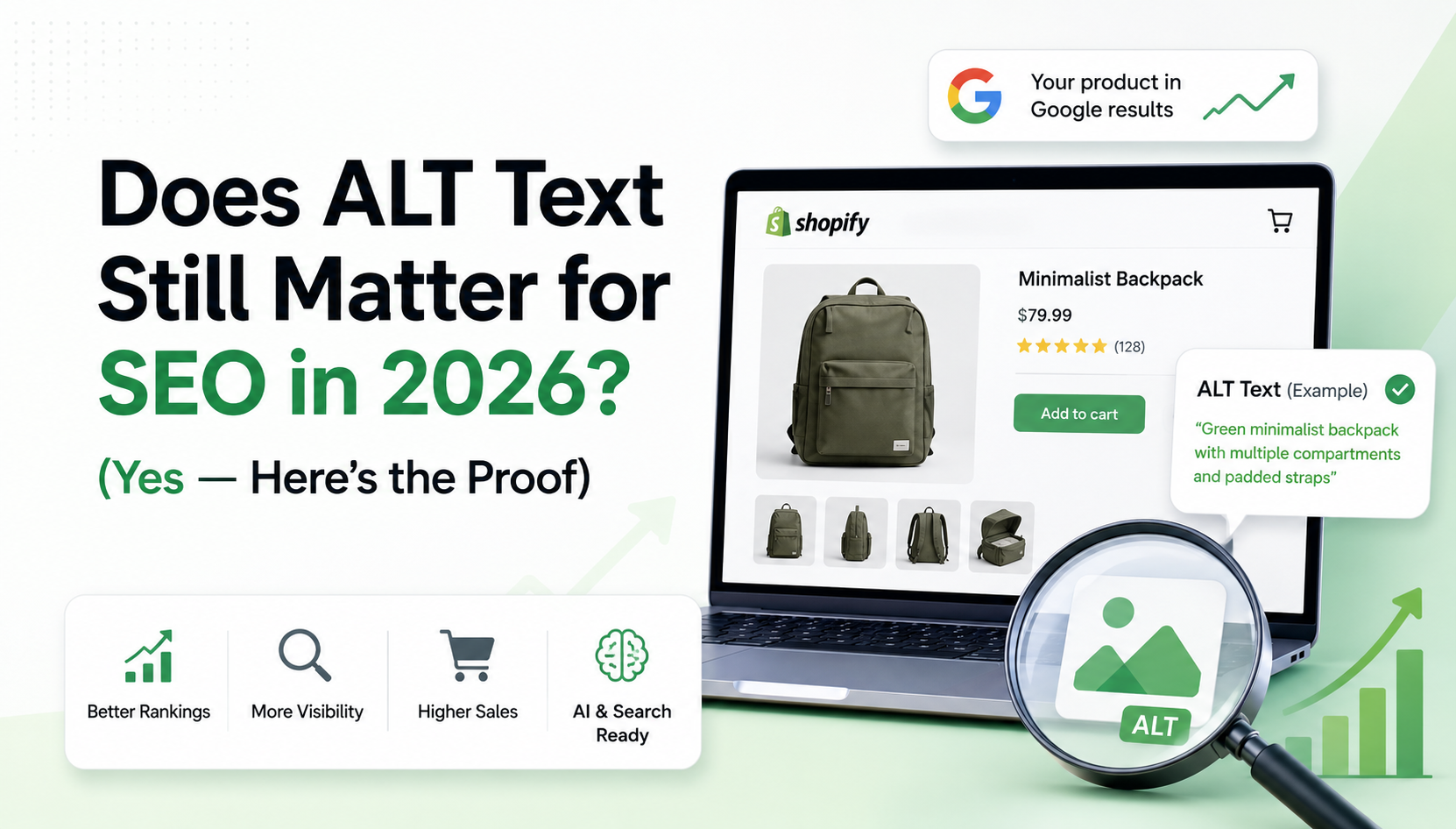
Every couple of years, someone declares ALT text "dead" for SEO. I've heard this claim since at least 2018, and it's never once held up. The role has shifted, sure - but the underlying need hasn't gone anywhere. If anything, 2026 is the year ALT text matters more, not less, because of how search itself has changed.
Let's get into the actual evidence, not just opinions.
The Quick Answer: Yes, But the Role Has Evolved
ALT text was never going to single-handedly rank a page - it never worked that way. What it does is feed context to systems that need text to understand what they can't visually perceive: search engines crawling your images, screen readers narrating your store to a blind shopper, and now, AI assistants like ChatGPT and Perplexity that read your product data rather than browse it.
That last one is the real shift in 2026. ALT text used to be mostly an image-search play. Now it's also part of how AI shopping tools decide whether your product even gets mentioned.
The Proof: What 2026 Data Says About ALT Text & SEO
Google's Own Stance on ALT Text as a Signal
Google has never wavered on this one: descriptive ALT text remains an important ranking signal for image search results and can reinforce the subject matter of the page it appears on. It's not a magic lever - but it contributes to how Google evaluates relevance for both the image and the page hosting it.
What's changed is how much weight image search itself carries. Fixing technical basics like Core Web Vitals, ALT text, and image optimization is enough to outrank a meaningful share of competitors who simply haven't bothered. That's a striking number for something so simple to fix. And the altmaster gets all covered.
The Accessibility-SEO Connection Nobody Talks About
Here's the part most SEO content skips entirely: accessibility and SEO aren't separate concerns, they overlap directly. Google treats accessibility as part of the overall user experience, and a website that's accessible to all users tends to be favored. Your ALT text isn't just feeding Google's crawler - it's literally what a screen reader announces to a blind shopper browsing your store.
And accessibility isn't optional anymore in many places. ADA-related digital accessibility lawsuits have climbed steadily for years, and missing ALT text is one of the most commonly cited issues in those cases. If you've been treating ALT text purely as an SEO nice-to-have, it's worth knowing it's also a compliance exposure.
Why "Image SEO" Has Become a Bigger Deal in 2026
Visual & Image Search Growth
Visual search hasn't slowed down - if anything, the way people search has fragmented across more surfaces: Google Images, Google Lens, Pinterest, and now AI chat tools that pull product recommendations from indexed data. Every one of those surfaces depends on text descriptions of images to function. No ALT text means no entry point into any of them.
Stricter Accessibility Laws Driving Compliance
Accessibility regulation has only gotten stricter, not looser. More regions are codifying digital accessibility requirements for e-commerce specifically, and the cost of non-compliance - legal exposure plus reputational damage - has only grown. ALT text sits right at the center of that requirement, alongside things like keyboard navigation and color contrast.
This breakdown of why ALT text matters for Shopify stores covers the SEO, accessibility, and legal angles together - worth a read if you want the fuller picture beyond just rankings.
What Good ALT Text Looks Like Today (With Examples)
The formula hasn't really changed, even as the stakes have gone up: describe what's actually in the image, specifically, in one natural sentence.
- ❌ shirt.jpg - no ALT text at all
- ❌ "blue shirt buy now best price men fashion" - keyword stuffing
- ✅ "Men's slim-fit Oxford shirt in navy blue, front view"
For lifestyle or in-context images:
- ✅ "Woman reading on a balcony with a Havana rattan chair"
Describe what's actually in the image using clear, specific language, thinking about what someone would need to know if they couldn't see it. If your primary keyword fits naturally into that description, include it. If it doesn't, leave it out - forcing it in does more harm than good.
The #1 Reason Shopify Stores Fall Behind on ALT Text
It's not laziness. Its volume.
Studies looking at large samples of websites have consistently found that even high-traffic, well-resourced sites only achieve roughly 50% alt-text coverage - and that's just measuring whether ALT text exists at all, not whether it's any good. For a Shopify store with a few hundred products and four or five images each, that gap isn't a minor oversight. It's potentially thousands of untagged or low-quality images sitting on your live store right now.
Coverage is only half the battle, though - the other half is making sure the images themselves are optimized before you even get to ALT text. If your product photos are oversized or inconsistently formatted, that's slowing down page speed and hurting SEO on top of the ALT text gap. Before you tackle ALT text at scale, it's worth checking that your images are sized correctly in the first place - our Shopify Image Size Guide 2026 breaks down the exact dimensions and formats Shopify recommends for product, collection, and banner images.
Manually fixing that is a multi-day project that most store owners start and never finish. That's exactly the gap AltMaster was built to close - it scans your entire catalog, flags every image with missing or weak ALT text, and lets you generate descriptions in bulk using template variables for product name, color, material, and variant. What would take days by hand takes minutes, and it keeps running automatically as new products get added.
Conclusion
ALT text isn't dead, and it isn't going to be made irrelevant by AI search either - if anything, AI search depends on it even more than traditional search did, because these tools have no way to "see" your images directly. The stores treating it as a one-time setup task are leaving real visibility on the table. The ones treating it as ongoing catalog hygiene are quietly building an advantage most competitors aren't bothering with.
Fix what you can today. Use a system for the rest.
FAQs
Has Google confirmed ALT text is a ranking factor in 2026?
Google has consistently said descriptive ALT text helps it understand and index images, and that it's an important signal for image search specifically. It's not a standalone ranking factor that moves a page to position one on its own, but it contributes meaningfully to how both the image and the page around it get evaluated.
Does ALT text help more for image search or regular search?
Image search, primarily - that's where its contextual role is most direct. But well-written ALT text also reinforces the overall topical relevance of the page it appears on, which can support regular search rankings indirectly, especially when the image content closely matches the page's subject matter.
Can AI-generated ALT text hurt my SEO if it's too generic?
Yes, if it's generic or repetitive across products. Generic AI output like "product image" or copy-pasted descriptions across every variant provides little value to Google or to screen reader users. Good AI-assisted ALT text still needs to be specific to each image - product, color, material, context - which is why template-based tools that pull in actual product variables tend to outperform plain AI generation.